

Table of Contents
- Medium Roast vs Dark Roast Coffee Beans: The Quick Comparison
- Coffee Roast Levels Explained: Where Medium and Dark Sit on the Scale
- Flavor Profile, Acidity, and Body: How the Two Roasts Taste
- Medium Roast vs Dark Roast Caffeine: Which Cup Hits Harder
- Brewing and Dialing-In: Water Ratios and the Best Roast for Espresso
- Storage, Shelf Life, and Antioxidants: What the Bag Doesn't Tell You
- How to Choose Coffee Beans for Your Setup and Your Palate
- The Verdict: Medium Roast or Dark Roast for Your Next Session
- Frequently Asked Questions
Last Updated: October 13, 2026
Medium Roast vs Dark Roast Coffee Beans: The Quick Comparison
Medium roast vs dark roast coffee beans comes down to one question: do you want to taste the bean's origin or the roaster's fire? Medium roasts keep the bean's natural character, with brighter acidity and a lighter body. Dark roasts trade that origin flavor for deep, smoky sweetness and a heavier mouthfeel.
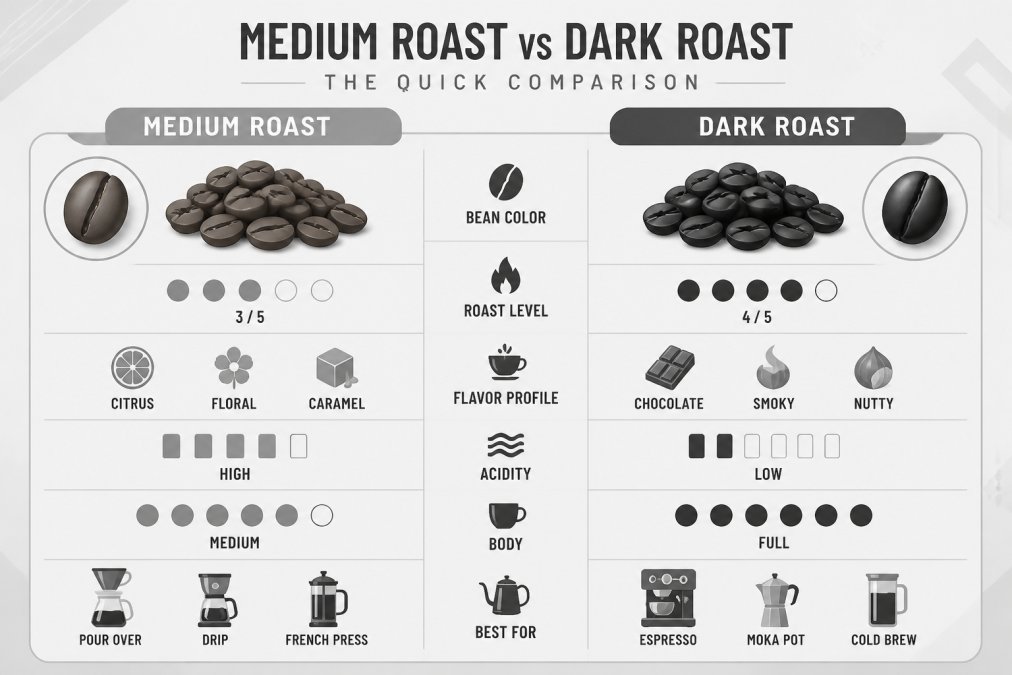
Here's the short version before we get into the details:
| Factor | Medium Roast | Dark Roast |
|---|---|---|
| Flavor focus | Origin, fruit, floral | Roast, caramel, smoky |
| Acidity | Moderate to bright | Low |
| Body | Medium | Full, syrupy |
| Surface oils | Minimal | Visible, shiny |
| Best brew method | Pour-over, drip | Espresso, French press |
We'll break down roast levels, flavor, caffeine, brewing, and storage so you can pick the right bag.

Coffee Roast Levels Explained: Where Medium and Dark Sit on the Scale
Coffee roast levels are defined by how far the bean develops inside the roaster, measured by internal bean temperature and the audible cracks the beans make as they expand. Medium and dark sit on opposite ends of that development curve, and the gap between them is wider than most people expect, roughly 40 to 60 degrees Fahrenheit of internal bean temperature separates a light-medium from a true dark roast.

What Happens During the Roasting Process
Green coffee beans start dense, grassy, and full of stored sugars and acids. Heat drives two big changes: the Maillard reaction, which builds brown color and savory-sweet complexity, and caramelization, which converts sugars into toffee and caramel notes.
That fracture is first crack. It typically lands somewhere between 385°F and 400°F internal bean temperature, and it sounds like popcorn popping. First crack marks the start of drinkable coffee. From there, roasters make their calls:
- Pull right at first crack: light roast territory. High acidity, tea-like body, origin flavors at full volume.
- Pull 30 to 90 seconds after first crack ends: medium roast. Sugars have developed, acidity has softened, origin character is still readable.
- Keep going toward second crack: the bean's cellulose structure starts to break down, oils migrate to the surface, and roast-driven flavors take over.
Second crack is a sharper, more rapid crackling sound, usually beginning around 435°F to 445°F internal bean temperature. By then, most of the bean's original acids and sugars have been transformed or destroyed, and roast flavor dominates the cup.
Light, Medium, Medium-Dark, and Dark: Reading the Labels
Labels vary by roaster, but the industry generally recognizes four bands:
- Light: Pulled right at first crack. Grassy, tea-like, high acidity. Often labeled "cinnamon roast" or "New England roast" on older American roasting charts.
- Medium: First crack finished, stopped before second crack begins. Balanced, origin-forward, medium body. Sometimes called "American roast" or "breakfast roast."
- Medium-Dark: Approaching second crack. Richer, sweeter, lower acidity. Often labeled "Full City" or "Vienna roast."
A useful rule of thumb: "French" or "Italian" means dark roast; "City" or "Full City" means medium to medium-dark; "Cinnamon" or "Half City" means light.
Our Specialty Coffee Association roast color standards reference is a useful benchmark when a bag's label feels vague. The SCA publishes color reference tiles that roasters use to calibrate their own naming, so you can compare a bag's stated roast level against an objective standard rather than marketing language.
Why the Scale Isn't Linear
The jump from light to medium is small in temperature, often 15 to 25 degrees, but large in flavor, because that window is where sugars caramelize and acids soften. The jump from medium to dark is larger in temperature but narrower in flavor range, because past second crack the bean mostly expresses roast character rather than origin. That's why two dark roasts from different origins can taste nearly identical, while two medium roasts can taste like entirely different beverages.
Flavor Profile, Acidity, and Body: How the Two Roasts Taste
The flavor profile of a medium roast leans fruity, floral, and nuanced. A dark roast tastes smoky, bittersweet, and intense. That split happens because roasting destroys some compounds and creates others.
Where Origin Flavor Goes After First Crack
Origin flavor is the taste of the coffee cherry's home: the soil, altitude, and processing that shaped the green bean. Medium roasts protect those notes; dark roasts cook them out. By second crack, most origin character is gone, replaced by roast flavor, which is why a dark roast from Ethiopia and one from Brazil can taste surprisingly similar.
Acidity here means brightness, not stomach acid. Medium roasts keep moderate acidity; dark roasts drop to low. Body is the weight on your tongue. Medium feels like skim milk; dark feels like cream.
Medium Roast vs Dark Roast Caffeine: Which Cup Hits Harder
Medium roast vs dark roast caffeine content is nearly identical by weight, and the myth that dark roast is stronger is backwards. Caffeine is heat-stable and barely degrades during roasting. What changes is bean density: dark beans lose moisture and expand, so they weigh less per scoop.
| Measurement | Medium Roast | Dark Roast |
|---|---|---|
| Caffeine by weight | Baseline | Nearly identical |
| Caffeine by scoop | Slightly higher | Slightly lower |
| Bean density | Higher | Lower |
| Perceived strength | Moderate | Bolder taste, not more caffeine |
For a long session, weigh your dose. It's the only way to know what you're actually drinking.
Brewing and Dialing-In: Water Ratios and the Best Roast for Espresso
The best roast for espresso is usually medium-dark or dark, because darker beans extract more predictably under pressure and produce thicker crema. Medium roasts can pull excellent shots too, but demand tighter dialing-in.
Water-to-Coffee Ratios by Roast Level
Water-to-coffee ratio is the weight of water divided by the weight of ground coffee. Most brewers land between 1:15 and 1:17.
- Medium roast, pour-over: Start at 1:16. Adjust finer if it tastes thin.
- Medium roast, drip: 1:17 works well; medium roasts forgive a wider range.
- Dark roast, French press: Start at 1:15. Dark beans extract fast.
Dialing-in means adjusting grind, dose, and time until the cup tastes balanced. Change one variable at a time.
Heroes Never Die Fighting Spirit Café | Dark Roast Coffee | Whole Bean →
Storage, Shelf Life, and Antioxidants: What the Bag Doesn't Tell You
Roast level also changes how fast your beans go stale, how you should store them, and how much of coffee's antioxidant content survives the roaster, practical differences the bag rarely explains.
Why Dark Roasts Stale Faster
During roasting, oils inside the bean migrate outward. In a light or medium roast, most stay locked inside the bean's cellulose structure.
Surface oils oxidize, tasting flat, rancid, or like cardboard. A properly stored medium roast holds peak flavor for roughly two to four weeks after the roast date; a dark roast often peaks earlier and fades within ten to fourteen days.
Storage That Actually Works
Three variables matter: oxygen, moisture, and light. Control all three and you extend the window for either roast.
- Airtight, opaque container at room temperature. A ceramic or stainless canister with a gasket seal beats a bag clip. One-way valve bags are fine short-term, but once opened, they let air in every time you reach for a scoop.
- Skip the fridge. Coffee is hygroscopic, it absorbs moisture and odors. A refrigerator cycles through both every time the door opens.
- Buy whole bean when you can. Ground coffee has far more surface area exposed to oxygen, so it stales in days rather than weeks regardless of roast level.
The Antioxidant Trade-Off
Chlorogenic acid is one of coffee's most-studied antioxidant compounds, and it degrades as roasting progresses. Lighter roasts retain more, darker roasts less.
The practical takeaway isn't that one roast is "healthier." If antioxidant content is one of your criteria, medium has the edge over dark.
For more on how roast level affects the compounds in your cup, see USDA research on coffee composition.
How to Choose Coffee Beans for Your Setup and Your Palate
Learning how to choose coffee beans comes down to three things: your brew method, your taste preference, and how fast you'll drink the bag. Roast level is the fastest filter.
- Love bright, fruity, tea-like cups? Go medium, especially single-origin.
- Want chocolate, caramel, and low acidity? Go dark.
- Brewing espresso? Medium-dark or dark for consistency.
Picking a Bag for Marathon Sessions
For long gaming sessions, the roast you'll keep drinking matters more than the roast that sounds impressive. A balanced medium roast like our Grinder Coffee Brew Mocha Java brings cherry and dark chocolate without fatigue, while our Heroes Never Die Fighting Spirit Café dark roast delivers bolder, low-acidity nutty caramel depth.
For a full-body middle ground, Java Supreme Ultimate Killing Machine sits at medium-dark with intense aroma. And if you want to taste what origin flavor actually means, Gamer Till the End Kenya AA is a medium roast with berry and citrus notes.

For broader guidance on brewing and bean selection, the National Coffee Association brewing resources are worth a read.
The Verdict: Medium Roast or Dark Roast for Your Next Session
Pick medium roast to taste where the coffee came from, with brighter acidity and a lighter body. Pick dark roast for bold, low-acid, caramel-and-smoke flavor that stands up to milk and long sessions.
Choosing the right roast is only half the battle. The other half is freshness, and that's where Spawn Point Coffee does things differently. We roast on demand, so your beans ship close to their roast date instead of sitting on a shelf for months.
Frequently Asked Questions
Which coffee roast has more caffeine, medium or dark?
By weight, medium roast usually edges out dark roast. Caffeine is fairly stable through roasting, but dark beans lose more mass to moisture loss and pyrolysis, so a scoop of dark roast contains slightly less caffeine than the same scoop of medium. Measured by volume, though, dark roast can win because the beans are less dense and pack tighter into a scoop. If you weigh your dose, the gap is small either way.
Are dark roast coffee beans less acidic than medium roast?
Yes. Longer roasting breaks down some of the chlorogenic acids and other compounds that read as brightness, so a dark roast typically lands lower in perceived acidity and higher in bitterness and smoky notes. Medium roasts keep more of that zesty, fruity character. If you get heartburn from bright single-origin cups, a medium-dark or dark roast is often easier on your stomach.
Is medium or dark roast better for espresso?
Both work, but they pull differently. Dark roasts extract faster and give you the classic thick, chocolatey, low-acidity shot with heavy body, which is forgiving if your dialing-in skills are still developing. Medium roasts need a finer grind and a slightly longer ratio to show their fruit and caramel notes. For a medium option built for espresso, Grinder Coffee Brew at $19.76 brings cherry and dark chocolate that holds up under pressure.
Can you use medium roast beans in an espresso machine?
Absolutely. Plenty of cafes pull medium roasts as espresso. The catch is that medium beans are denser, so you usually grind finer and may need a longer extraction to hit a balanced shot. Expect 18 grams in and 36 to 40 grams out over 28 to 32 seconds as a starting recipe, then adjust by taste. If the shot tastes sour, grind finer; if it tastes harsh, back off.
How do you choose coffee beans for long gaming or streaming sessions?
Match the roast to how you brew and how you want to feel. A medium roast gives you steady, even energy with fruit and caramel notes that stay interesting over an eight-hour stream. A dark roast delivers a bolder, heavier cup that many people find more comforting at 2 a.m. Buy whole bean when you can, store it away from light and heat, and keep a one-pound bag like Heroes Never Die Fighting Spirit Cafe at $18.96 on rotation so it never goes stale.