

Table of Contents
- Quick Comparison: Best Coffee Beans for Home Espresso
- How to Dial In Espresso Beans for Consistent Shots
- Single Origin vs Blend for Espresso: Which Wins at Home?
- How to Store Coffee Beans for Freshness
- Top Picks: Best Coffee Beans for Home Espresso from Spawn Point Coffee
- Troubleshooting Common Espresso Extraction Failures
- Frequently Asked Questions
Last Updated: September 27, 2026
Quick Comparison: Best Coffee Beans for Home Espresso
The best coffee beans for home espresso are fresh, dark-roasted, 100% Arabica beans ground fine enough to pull a 25-30 second shot. At Spawn Point Coffee, we roast on demand so every bag reaches your grinder at peak flavor.
What to Look for in Espresso Beans
Look for four things: a roast date within the last few weeks, 100% Arabica beans, a dark or medium-dark roast profile, and a grind that matches your machine. Espresso is a brewing method, not a bean type, the difference is extraction under pressure.
A few selection criteria that actually matter:
- Roast date, not "best by" date: Freshly roasted beans taste better and produce thicker crema.
- Roast level: Dark and medium-dark roasts extract more predictably and cut through milk.
- Bean density: Denser beans resist over-extraction and hold up to pressure.
- Grind consistency: Uneven grinds cause channeling and sour or bitter shots.
How to Dial In Espresso Beans for Consistent Shots
Dialing in means adjusting grinder and dose until the shot tastes balanced. Start with a 1:2 ratio (18 grams in, 36 grams out) in 25-30 seconds, then adjust one variable at a time.
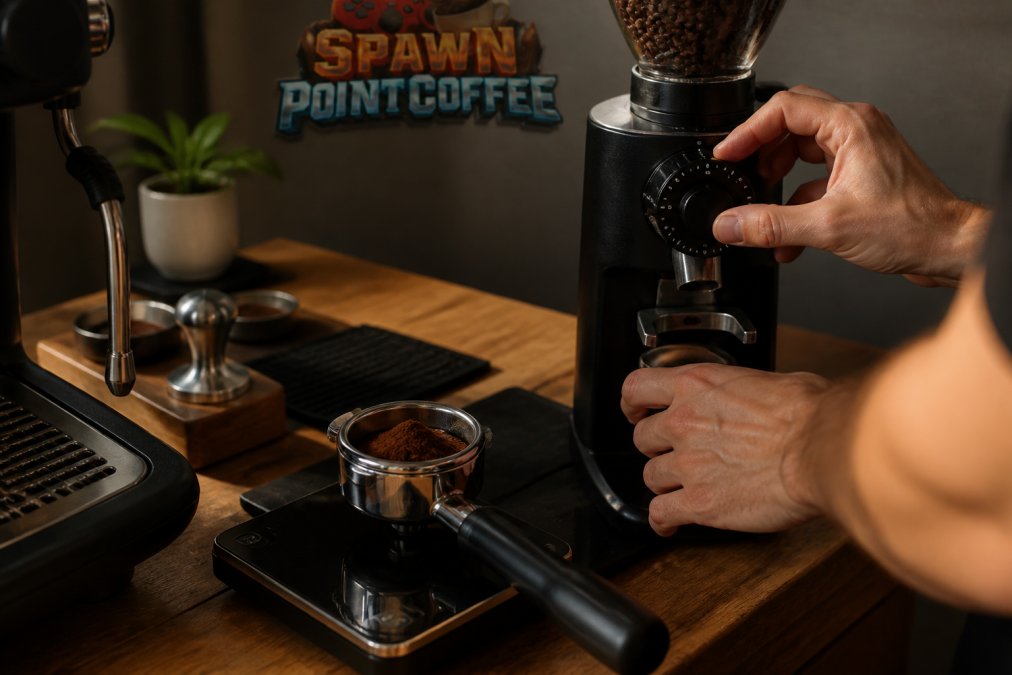
The process is simple:
- Weigh your dose. Use a scale, not a scoop. Start at 18 grams.
- Set your grind. Aim for fine, like table salt.
- Pull a shot and time it. Target 25-30 seconds.
- Taste it. Sour means under-extracted, bitter means over-extracted.
- Adjust one thing. Grind finer if sour, coarser if bitter.
The Variables That Matter
Espresso extraction is controlled by several interacting variables:
- Grind size: The most important variable. Finer grind increases resistance and extraction time; coarser decreases both. Adjust in small increments, a 1-2 click change on a stepless grinder is noticeable.
- Dose: The coffee in the basket. More coffee means more resistance and a slower shot. If you change dose, adjust grind to keep the same flow rate.
- Water temperature: Most machines brew between 195°F and 205°F. Lighter roasts want 200-205°F for sweetness and acidity; darker roasts want 195-200°F to avoid bitterness.
- Pressure: Standard is 9 bars. Some machines allow pressure profiling, which helps light roasts. With fixed pressure, adjust grind and dose instead.
- Basket size: An 18g vs. 22g basket changes how much you can dose. Match dose to basket capacity.
Dialing In by Roast Level
Different roast levels require different starting points.
- Dark roasts (French, Italian): More soluble and extract quickly. Start coarser at 195-198°F, targeting a 1:2 ratio in 25-28 seconds. If ashy or bitter, grind coarser.
- Medium roasts: The most forgiving. Start at 200°F and a 1:2 ratio in 27-30 seconds. Adjust grind to taste.
- Light roasts: Denser and less soluble. You may need a finer grind, 202-205°F, and a longer ratio (1:2.5 or 1:3). They taste sour if under-extracted, so push extraction further.
Using a Bottomless Portafilter to Diagnose
A bottomless portafilter (bottom cut out) lets you watch the extraction. Look for:
- Even flow from the start: All basket holes should start dripping at once. If one area starts first, distribution is uneven.
- No channeling: Channeling is when water finds a path of least resistance and shoots through in a thin stream, causing sour and bitter flavors in one shot. Fix with better distribution (WDT tool) and level tamping.
- Honey-like flow: A good shot starts slow, then thins into a honey-like stream. If it gushes from the start, grind finer.
When to Adjust Dose vs. Grind
Simple rule:
- If the shot tastes sour and runs fast: Grind finer first. If that makes it too slow, increase dose slightly.
- If the shot tastes bitter and runs slow: Grind coarser first. If that makes it too fast, decrease dose slightly.
- If the shot tastes balanced but the yield is off: Adjust dose to hit your target yield without changing grind.
Resting Beans Before Dialing In
Freshly roasted beans release CO2 for several days, causing gushing shots and uneven flow. Most roasters recommend resting beans 5-7 days after roast before pulling espresso; light roasts may need 7-10 days. Beans only 2 days old dial in inconsistently.
Single Origin vs Blend for Espresso: Which Wins at Home?
Blends win for most home setups because they're built for balance and consistency. Single origin beans shine when you want a specific flavor profile and don't mind dialing in more carefully.
| Factor | Single Origin | Espresso Blend |
|---|---|---|
| Flavor | Distinct, variable | Balanced, consistent |
| Dialing in | Harder | Easier |
| Best for | Flavor explorers | Daily drivers |
| Sweetness | Varies by origin | Engineered in |
| Solubility | Varies widely by origin and processing | Formulated for even extraction |
| Cost per pound | Often higher for micro-lots | Typically lower at scale |
Why Blends Are Easier to Dial In
Blends are engineered so different beans extract at similar rates. A roaster might combine a washed Brazilian (nutty, low acidity, highly soluble) with a natural Ethiopian (fruity, higher acidity, less soluble) so the shot tastes balanced across a wider range of grind settings, forgiveness that matters while learning your grinder.
Equipment-Specific Pairing
Your machine changes which beans work best. How to match beans to your setup:
- Pressurized basket machines (entry-level): These use a pressurized portafilter to create artificial resistance. They're forgiving of stale beans and coarse grind but mute flavor differences, so a medium-dark blend with chocolate and caramel notes stays consistent. Don't waste money on a delicate single origin, the pressurized basket flattens its nuance.
- Standard 58mm commercial-style machines (e.g., E61 group head, dual boiler): These demand fresh beans and a quality burr grinder. A blend roasted for espresso works well, but you can explore single origins too. Look for beans roasted within 2-3 weeks and rest them 5-7 days after roast.
- Manual lever machines: These give you pressure control, so you can experiment with lighter roasts and single origins that would be difficult on a pump machine. A light-roasted Ethiopian natural can produce a syrupy, berry-forward shot if you profile the pressure correctly.
Water Chemistry Impact
Water makes up about 98% of your espresso, and its mineral content changes how beans extract. Too soft (low minerals) and the shot tastes flat; too hard (high calcium and magnesium) and you get chalky, bitter notes plus scale buildup.
Decaf Espresso Performance
Decaf beans can pull excellent shots if you choose the right ones. The decaffeination process (Swiss Water Process, CO2, or solvent-based) affects bean density and solubility. Swiss Water Process decafs tend to be more porous and extract faster, so grind a touch finer or lower your dose by 0.5-1 gram. Look for decafs clearly labeled with the process and roasted recently, stale decaf tastes flat and papery.
Troubleshooting Bean-Related Extraction Issues
If your shots taste sour or bitter despite correct grind and dose, the beans may be the problem:
- Sour, thin, or salty shots: Beans are under-extracted. This can happen with very light roasts or beans that are too fresh (less than 3 days post-roast). Let them rest longer or grind finer.
- Bitter, harsh, or ashy shots: Beans are over-extracted. Dark roasts are more soluble, so they can turn bitter quickly. Try a coarser grind or lower water temperature (around 195°F instead of 200°F).
- No crema or thin crema: Beans are stale. Crema comes from CO2 released during roasting. If the roast date is more than 4-6 weeks ago, the beans have lost most of their gas. Buy fresher beans.
- Inconsistent shots from the same bag: The beans may be a blend with uneven roast levels, or your grinder is producing inconsistent particle sizes. Check your burr alignment.
How to Store Coffee Beans for Freshness
Store beans in an airtight, opaque container at room temperature, away from light, heat, and moisture. Skip the fridge and freezer for daily-use beans. Oxygen, light, and heat are the three enemies of fresh coffee.
- Do: Keep beans in a sealed canister in a cool cupboard.
- Don't: Store them in the hopper for weeks.
- Do: Buy in quantities you'll finish in 2-3 weeks.
- Don't: Freeze and refreeze the same bag.
Top Picks: Best Coffee Beans for Home Espresso from Spawn Point Coffee
Spawn Point Coffee roasts on demand, so every bag ships fresh. Here are the espresso roasts we recommend for home setups, all $19.76 for a 1-pound bag.
Troubleshooting Common Espresso Extraction Failures
| Problem | Likely Cause | Fix |
|---|---|---|
| Sour, thin shot | Under-extracted | Grind finer or increase dose |
| Bitter, harsh shot | Over-extracted | Grind coarser or lower dose |
| Gushing, fast shot | Grind too coarse | Grind finer |
| Slow, dripping shot | Grind too fine | Grind coarser |
| No crema | Stale beans | Buy fresher, recently roasted beans |
Specialty Coffee Association extraction research explains how grind uniformity and water contact time affect flavor balance.
Frequently Asked Questions
What is the 30-second rule for espresso?
The 30-second rule is a guideline for espresso extraction time. A standard double shot should take roughly 25 to 30 seconds from the moment you start the pump until you stop it. If your shot runs faster, the grind is too coarse and the espresso will taste thin and sour. If it runs slower, the grind is too fine and the shot will taste bitter and burnt. Use this as a starting point, then adjust your grind to taste.
Which roast level is best for making espresso at home?
Medium to dark roasts work best for home espresso. Darker roasts like Italian or French roast produce a richer, heavier body with lower acidity, which helps balance the intense pressure of espresso extraction. Lighter roasts can work but often taste sour or underdeveloped unless you dial in your grind and temperature carefully. For most home setups, a dark roast like the Triumph & Glory Adventurer's Espresso Supremo or All 4 Gamers Up All Night French Roast delivers consistent, flavorful shots with less fuss.
Are single-origin beans better for espresso than blends?
It depends on what you want from your shot. Single-origin beans highlight one region's flavor notes, which can be bright and complex but sometimes harder to balance in espresso. Blends combine beans from multiple origins to create a more consistent, balanced profile with better body and sweetness. For home espresso, blends are often more forgiving and reliable. If you enjoy experimenting with flavor, try single origin vs blend for espresso side by side and see which suits your taste.
How does bean freshness affect the quality of home espresso?
Freshly roasted beans make a noticeable difference in home espresso. Beans hit peak flavor roughly 5 to 14 days after the roast date, then slowly decline. Stale beans produce flat, lifeless shots with little crema. Always check the roast date on the bag, not just the best-by date. Spawn Point Coffee roasts on demand, so your beans arrive close to their peak window. Store them in an airtight container away from light and heat to keep them fresh longer.
What is the difference between espresso beans and regular coffee beans?
There is no botanical difference. Espresso beans are simply coffee beans roasted and sometimes blended specifically for espresso extraction. They tend to be darker roasted to stand up to the pressure and short brew time. Regular coffee beans may be lighter roasted for drip or pour-over methods. You can use any coffee bean in an espresso machine, but beans labeled for espresso are chosen for how they perform under pressure. Roast profile, grind consistency, and freshness matter more than the label.
Great espresso at home comes down to fresh beans, a consistent grind, and patience while you dial in. Spawn Point Coffee roasts every bag on demand, so your beans arrive at peak freshness instead of sitting on a shelf. Choose from whole bean or espresso ground options like Triumph & Glory Adventurer's Espresso Supremo or All 4 Gamers Up All Night, and get freshly roasted fuel built for long sessions. Get started with Spawn Point Coffee and pull better shots from your first bag.